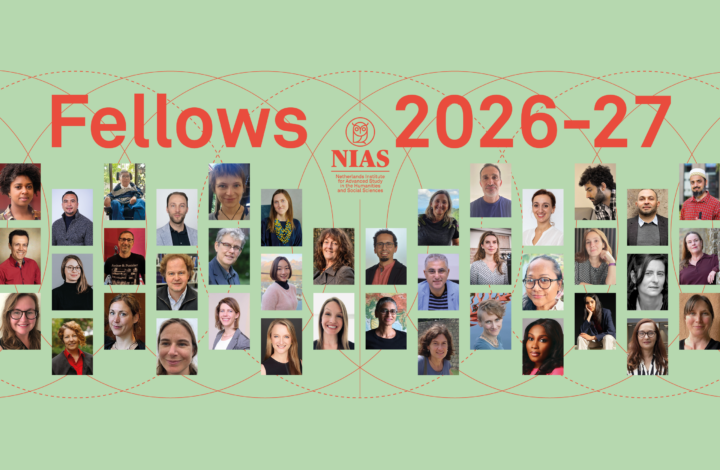
NIAS welcomes fellows for 2026–2027
Time and space to follow questions wherever they lead
18 August 2026Their work spans early modern mapmaking, Amazigh culture, Ukrainian youth resilience, socialist organising in the late Ottoman Empire, and much more. The Theme Group Defamiliarizing Geslacht examines how gender, generation and other dimensions of social difference interact, approaching familiar questions from unfamiliar angles. The NIAS-Lorentz Theme Group Abstraction, Broad Generalisation, and Composition: the ABCs of Analogy asks how analogical reasoning – the ability to use relational abstractions to learn from and generalise to novel situations – develops in humans, and whether it might be replicated in machines. Meanwhile the Theme Group Academic Freedom in Context looks at concerns over the erosion of liberal democracy worldwide, through the lens of legitimising institutions such as courts, universities and media.
A diversity of standpoints
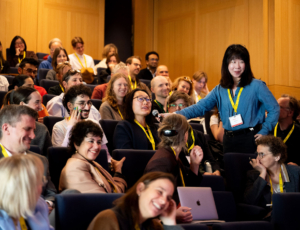
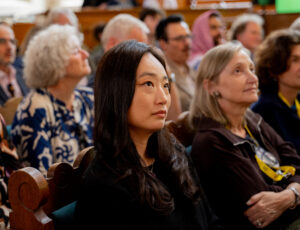
The 2026–2027 cohort reflects not only a diversity of disciplines and backgrounds, but also a diversity of standpoints – different positions from which people experience, interpret and make sense of the world. Bringing such standpoints together does not necessarily produce agreement. It can expose assumptions, unsettle familiar categories and make visible questions that look very different depending on where one stands.
Universities do not sustain open societies alone. Journalism, the arts, the judiciary and civil society likewise depend on institutions in which received ideas can be questioned and alternatives imagined. NIAS sees itself as part of this wider intellectual and democratic ecology.
In welcoming the fellows of 2026–2027, NIAS reaffirms its commitment to academic freedom: creating the conditions for it, studying the forces that threaten it, and defending the independent thinking on which it depends.
Meet the fellows
List of fellows for the academic year 2026 – 2027
- Mehrdad Alipour – Non-Binary Intersex and Its Legal Implications in Nineteenth-Century Shiʿi Discourse
- Iuliia Anosova – Legal Mobilization through Cooperation: Seeking Accountability for the International Crimes Committed in the Context of Russia’s War against Ukraine – Safe Haven Fellow
- Abdullah Awad – A Classifying Otherwise: Metadata, Epistemology, and the Democratic Mandate of the Library – KB Fellow
- Abdeslam Badre – Positionality, Reflexivity, and Knowledge Production about the Moroccan Diaspora in the Netherlands
- Stefo Benlisoy – Workers of Istanbul Unite! A Socialist Workers Organisation in the Late Ottoman Capital 1909–1922
- Eric Boot – Climate Change and Complicit Lawyers
- Sarah De Mul – The Art of Burnout
- Raquel Irene Drovetta – Feminist Activism and Self-Managed Abortion Manuals in Latin America and the Caribbean
- Catarina Dutilh Novaes – Towards a Counter-Colonial Epistemology and Philosophy of Science – Distinguished NIAS Lorentz Fellow
- Laura Fair – Swahili Foodways
- Charlotte Fourneuf-Niel – Recording the Present: A Curatorial Jump into the Everyday Practice in Performing Arts – Nouveau Grand Tour Fellow
- Michael Funke – The World Economy’s Shifting Winds: Geopolitical Shocks and Challenges – Duisenberg Fellow
- David Gómez Gamboa – Bridging Gaps in International Law on Academic Freedom and State Responsibility: A Latin American Approach
- Nina Holvast – Transformation into a Lawyer: The Legal Profession’s Influence in Law School Socialisation
- Margriet Hoogvliet – Uncovering Early Modern Women Mapmakers in Amsterdam: A Re-Evaluation of Archival Records and Broader Contextualisation
- Franka Hummels – Missing Minsk – Fonds BJP Fellow
- Jisu Kim – Voices of Migrant Workers: Online Narratives of Labour Market Inclusion and Exclusion in the Netherlands – Instituut Gak Fellow
- Christian Long – American Spy Novels and the Locations of Espionage, 1965–2020
- Zainab Musa Shallangwa – Our Voices Matter: Exploring Local Perceptions on the Restitution Issue in Benin City, Nigeria
- Mohamed Oubenal – The Transformation of Amazigh Culture in Urban Areas
- Iuliia Pavlova – Youth Resilience in Ukraine (YRU): Longitudinal Trajectories of Youth Mental Health, Relationships, and Resilience – Evidence for Policy and Practice – Safe Haven Fellow
- Lou-Poko Savadogo – Turn a Blind Eye – Nouveau Grand Tour Fellow
- Nandita Sharma – The Figure of the Foreigner in Colonial, Anti-Colonial, and Postcolonial Thought and Practice
- Alexa Stoicescu – Writing Relationships: Towards a Relational History of Dutch-language Literature from the Avant-Garde to the Present
- Ruth Rebecca Tietjen – Affective Radicalization: A Conceptual Analysis
- Antoni Tsaputra – Beyond the Gate: What Indonesia Can Learn from the Netherlands’ Deinstitutionalisation Journey
- Moiz Tundawala – Legalizing Sovereignty in South Asian Constitutionalism
- Hanna Valynets – Only Stories Left: How Authoritarianism Decreases the Space for Public Discussion and Private Opinions on Social Media – Safe Haven Fellow
- Meta van der Linden – Policies That Work? Evaluating Dutch Integration Policies for Refugees’ Labour Market Participation – Instituut Gak Fellow
- Yulianti – Locating Religious Objects in the Lombok Collection
Theme groups
NIAS Theme Group | Academic Freedom in Context
- Kimberly Wehle – Institutional Vulnerabilities and Democratic Resilience in an Age of Rising Autocratization and AI – Coordinator
- Sari Hanafi – Toward a Dialogical Liberal Project
- Vicky Kosta – The EU Fundamental Right to ‘Freedom of the Arts and Sciences’: Exploring the Limits on the Commercialisation of Academia
- Tamar de Waal – Between Vulnerability and Resilience: Institutional Dynamics of Autocratisation
NIAS Theme Group | Defamiliarizing Geslacht
- Geertje Mak – A Race without Geslacht? Blood(lines) in Physical-Anthropological Research in Dutch New Guinea (1920–1962) – Coordinator
- Ana Eclair – Reimagining Relatedness: Family Constellation Therapy and Immersion into the Unspeakable
- Silvia Sebastiani – Reproduction and the Making of Humanity in the Enlightenment
- Helmer Helmers – Defamiliarizing Geslacht – Associate Theme Group Fellow
NIAS-Lorentz Theme Group | ABCs of Analogy
- Lucia Donatelli – Language and Analogical Reasoning – NIAS-Lorentz Theme Group Coordinator
- Martha Lewis – Neurosymbolic Models of Analogy – NIAS-Lorentz Theme Group Fellow
- Claire Stevenson – Tracing Analogical Reasoning Development in Children and AI Models – NIAS-Lorentz Theme Group Fellow