

NIAS Theme Group Fellowships
The Fellowship call (for the 2027–2028 academic year) was open from 15 January 2026 until 16 March 2026, 12:00 noon CET.
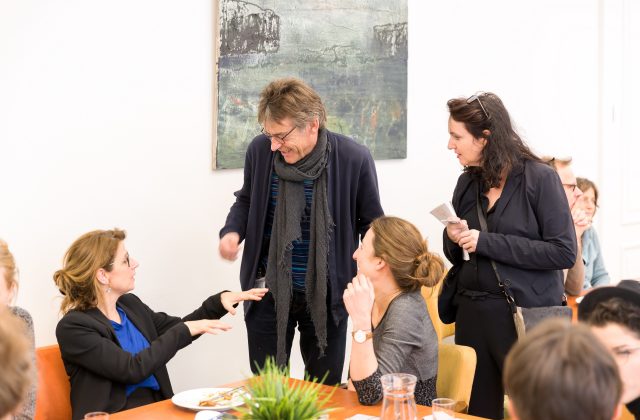
During the semester, the members of the Theme Group works on a self-chosen project within the humanities and/or social sciences, collaborating daily on the shared research topic. It is a true residency, as fellows step away from their regular obligations to dedicate themselves fully to their research. In addition to offering uninterrupted time and space for research, the residency provides daily opportunities to connect with other fellows, in an international, multidisciplinary environment that promotes both intellectual and informal exchange among residents. Participation in communal lunches and weekly seminars, where fellows present their work-in-progress, is a central aspect of the NIAS Fellowship experience.
To ensure the highest quality of the residency, NIAS requires fellows to be present at the Institute for at least four days per week, including attendance at the weekly fellows’ seminar on Thursdays. We strongly recommend that fellows make the necessary arrangements with their home institutions before the start of the fellowship to enable full immersion in the residency.
More information on:
Who can apply
NIAS Fellowships are awarded to scholars from both the Netherlands and abroad. Applicants should have at least three years of academic experience since obtaining their PhD, and their project proposal should be related to the fields of Humanities and Social Sciences.
These fellowships are also open to scholars who do not hold a permanent position at a university or research institute. The working language at NIAS is English, and applicants are expected to have a strong command of the language in order to contribute fully to the fellows’ group and to benefit from feedback on their own research.
NIAS seeks to assemble a balanced cohort each year, reflecting a diversity of academic cultures, gender, career stages, and disciplines.
For a complete list of the formal requirements please see here.
NIAS aims to grant equal freedoms and rights to all researchers. We will not exclude individual researchers based on their nationality, ethnicity, religion, or affiliation, and are dedicated to ensuring that everyone in our community feels safe among their peers. However as of March 2022, as part of the EU sanctions in response to the Ukraine crisis, NIAS is forced to deny applicants (whatever their nationality) affiliated to Russian or Belarusian universities and research institutes. Applicants with a Russian or Belarusian nationality who are independent or are affiliated to a research institution outside Russia or Belarus, are eligible.
-
Read more about "The collaborative approach to knowledge generation is refreshing"
"The collaborative approach to knowledge generation is refreshing"
More
Theme Group application
The Theme Group application consists of two parts: the group proposal and the individual fellowship application forms of all group members.
The group proposal (max. 1500 words, including footnotes, excluding bibliography and abstract) should include:
- Title, topic and main idea of the theme group project
- Relation of the project to existing literature in the field
- Academic and societal relevance of the research project
- Methodology
- A description of the interdisciplinary character of the proposal, the expected benefit of group collaboration, and how the NIAS environment will contribute to this collaboration
- Intended research output (e.g. lectures, articles, monographs, constitution of databases, websites)
- A definitive list of the theme group members (min. 2 – max. 4)
The group proposal must be submitted via the application form on this website. In addition, all theme group members, including the coordinator, must submit their own individual application with a research proposal for their own project. We recommend that the theme group coordinator oversees this process, as only complete applications – including the individual fellowship forms of all members – will be considered for evaluation.
For your convenience, a blank application form is provided to give you an idea of the information required.
Please note that this form is a sample, some details may have changed in this year’s application.
Selection procedure
The selection procedure for a NIAS theme group consists of:
First stage: eligibility
In order to be eligible for a NIAS Fellowship, candidates must meet all formal eligibility criteria that are communicated with the call. By 1 May Team Selection at NIAS will let applicants know by email if their application does not comply with these criteria, and is therefore rejected. Please, note that among them are those conditions concerning the maximum lengths of your entries and submitted documents. NIAS will not allow any additions or changes after submission.
Second stage: commitment
A NIAS Staff Committee, composed of members not otherwise involved in the selection procedure, assesses the applicants’ commitment – NIAS’s core value. They review the candidates’ statements on interdisciplinary and community engagement and propose up to 150 candidates for the reviewing phase, taking into account the level of dedication and care evident in the applications. Candidates not proposed for review will be notified by email before 15 May. The lists are compiled into a matrix produced by the Staff Committee, which presents the geographic distribution, disciplinary diversity, and various career stages of the cohort-in-the-making.
Third stage: peer review
Applications that meet the stated requirements will be forwarded to two selected external referees. These referees are chosen either from NIAS’s expanding panel of reviewers or from the three referees proposed by the applicant.
The NIAS panel represents a diverse range of expertise and backgrounds. All referees are provided with a set of evaluation guidelines, which include consideration of the applicant’s personal circumstances when preparing their proposal.
By the end of September, the dossiers of the 75 highest-rated applications will be submitted to the NIAS Academic Advisory Board. A more concise overview will be provided for the other applicants.
Fourth stage: NIAS Academic Advisory Board (AAB)
The three Theme Group applications with the highest scores from the referees’ evaluations are presented to the AAB. This board is responsible for advising the NIAS Directorate on which candidates should be invited as fellows.
As part of this role, the board ranks the candidates presented to them in dossiers. They are specifically asked to consider the overall balance of the proposed year group, taking into account factors such as discipline, gender, seniority, and regional diversity.
Fifth stage: final selection by the director of NIAS
Based on the board’s recommendations, the NIAS Director makes the final decision on fellowship allocations.
While academic considerations – both individual excellence and the potential impact on the collective of fellows – remain the priority, practical factors may also be considered at this stage. These include the availability of housing and other resources relative to demand, for which the Institute Manager will be consulted.
The Director of NIAS informs the theme group coordinator in writing of his decision no later than 15 December in the year that the application was submitted i.e. theme groups who have been selected, theme groups who have not been selected and theme groups who have been placed on the reserve list.
Accepted candidates receive a Preliminary Offer, and upon acceptance, a Fellowship Agreement will be issued along with any relevant attachments and documents. Full agreement must be reached and signed by 15 April, after which the offer will expire. Offers cannot be deferred to a future year.
If an accepted candidate declines or their offer expires, the Director will offer the position to an alternate candidate. By 15 May, the final NIAS year group for the upcoming academic year will be confirmed and ready for presentation in August.
The selection process takes up to 12 months.
-
Read more about "To work together in such a focused manner is just what we needed to start up a new interdisciplinary agenda" by Arche, María J.
"To work together in such a focused manner is just what we needed to start up a new interdisciplinary agenda"
More
Time path
Call for NIAS theme group proposals for the academic year 2027/28:
- Call opens: 15 January 2026
- Call closes: 16 March 2026, 12.00h noon CET
- If the application does not meet the formal requirements the application will be rejected and the applicant will be informed by email before 1 May 2026.
- Candidates not proposed for review will be notified by email before 15 May.
- The Director of NIAS informs all eligible candidates in writing of his decision no later than 15 December 2026
Previous NIAS Theme Groups include:
- Ecology and Belonging: In Search of a New Political Space
- Early Dutch Commerce and Indigenous Landscapes
- Re-imagining Security Labour
- Future of Progressive Politics
- The Spatial Segregation of Neighborhood Organizations and Entrepreneurs: Connecting Urban Inequality to the Built Environment
- Political theories of involuntary servitude within Europe (1600 – 1850)
- The Politics of Defamiliarization: the Common and the Strange in Contemporary Europe
- Legal Mobilization: Analyzing Law-based Advocacy
- Commodity Frontiers and the Making of Global Capitalism
Past & present Fellows
-

-

-

Poster, Winifred
Year Group 2023/24 Disciplines: Labor Studies, Science and Technology Studies, Sociology -

-

-
-
-

Stacey, Timothy
Year Group 2025/26 Disciplines: Anthropology, Cultural Analysis, Environmental Science, Geography, Religious studies and theology, Sociology -

-

Jhagroe, Shivant
Year Group 2025/26 Disciplines: Anthropology, Environmental Science, Philosophy, Public administration and political science -

-

-

-

Khiatani, Paul Vinod
Year Group 2025/26 Disciplines: Psychology, Public administration and political science, Sociology -

-
-

-

-
-

-
-
-
-
 Fellowship
NIAS-Lorentz Theme Group Fellowships
-
 Fellowship
NIAS Fellowship
-
 Theme Group
Early Dutch Commerce and Indigenous Landscapes
-
 Theme Group
Future of Progressive Politics