The foundation is now crumbling
A diner pensant on the pillars and foundations of the democratic rule of law, held on 8 December 2025 at the NIAS Fellows House in Amsterdam
By Mark Lievisse Adriaanse, journalist at NRC and NIAS Alum
In the impressive opening of The World of Yesterday, the Austrian writer Stefan Zweig describes how absurd it would be to search for his country of birth on a world map; it no longer exists. The Austrian metropolis in which he grew up has, he writes, meanwhile been reduced to a German provincial town. The world of certainty and law, in which the state seemed unassailable and “the rights it granted its citizens were guaranteed by parliament”, was no more, Zweig describes in the book suffused with nostalgia for a lost world.
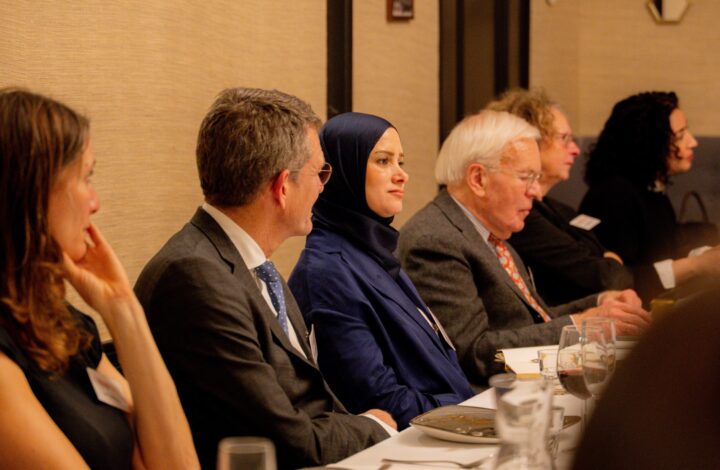
The world of 2025 is a different one. Yet a comparable feeling – that what is of value is slipping through one’s fingers, that old certainties are suddenly faltering and that norms, rules and institutions long taken for granted are now being called into question; that, in other words, this world too may become a world of yesterday – hangs in the air in early December in the large dining hall of the NIAS Fellows House on the Kloveniersburgwal in Amsterdam.
Among those at the table are a court president, a Vice-President of the Council of State and one of his predecessors, leading professors of domestic and international law, virology and political science, artists and writers. On the table are plates with a rijsttafel and bottles of wine that remain largely untouched; Monday evening does not readily lend itself to a bacchanal. And what is being discussed is too serious for that.
Jan Willem Duyvendak, the NIAS director who will soon retire, had opened the evening by explaining how important it is “to discover what we have in common, what vulnerabilities exist within the social spheres, and what we can offer one another in order to confront the major threats of today”. Grand words, he knows, because “everything is quickly labelled a crisis nowadays. So we must be more precise: not equally alarmist in every case and looking at what the greatest threats are.” Yet still: “I think many of us have found it hard to imagine how quickly the situation deteriorates in many countries, but also closer to home and in the Netherlands as well. Things can shift rapidly, particularly in contexts where the radical right is very strong.”
Ingrid Leijten, professor of constitutional law (Chair of Dutch and European Constitutional Law) at Tilburg UniversityUndermined by autocrats in every possible way
Chair Tom-Jan Meeus then begins a round of questions. What is the state of what the guest of honour, emeritus professor of sociology Kees Schuyt, calls “the pillars of the democratic rule of law”?
The domestic legal order, begins professor of constitutional law Ingrid Leijten: “I am concerned about that. The narrative we tell about the democratic rule of law is being undermined by autocrats in every possible way. The importance of facts, the protection of minorities: these are being chipped away. Much of what we have seen in recent years in the United States and Poland we are seeing on a smaller scale in the Netherlands too.”
Democracy, says vice-president of the Council of State Thom de Graaf, “is under pressure. Democracy and the rule of law are not available separately, as Ernst Hirsch Ballin once said. A democratic rule of law that is not supported by society or where that society has no understanding of what it entails has little value. If Ministers of the Crown and Members of Parliament disagree with advice from the Council, that is fine. If something else is at play – if they distrust the institution as such and do not regard what we do as legitimate – then there is a larger problem. That seems increasingly to be the case.”
Breeding discontent
The international legal order, say Andre Nollkaemper and Rolien Sasse, is in decline. Sasse: “Countries that claimed to uphold that legal order have, in the eyes of many states, betrayed it through their support for Israel. In our networks you can no longer get away with invoking it. The legal order had a dampening effect: even leaders who violated it felt compelled to cloak their violence in legal terms. They no longer consider that necessary. That is dangerous; the legal order then ceases to matter.” Nollkaemper: “I share the sombre assessment. But I would add: international law not only safeguards peace between states, it also provides within states an anchor for the protection of citizens against the executive. That too is beginning to waver.”
The media, says Groene editor-in-chief Xandra Schutte, “are under pressure on the one hand from populists and their insinuations, which sow distrust and undermine facts, and on the other hand the stormy development of Big Tech is eroding the traditional media’s revenue model. At the same time, the media are also the platform where we ask how it is that we experience so much polarisation in the Netherlands and why the radical right is so successful. Why does it resonate so strongly? If you examine that, you see that the government has made many mistakes, of which the childcare benefits scandal and the faltering recovery after the earthquakes are the most striking. At De Groene we also investigated where citizens can obtain justice. Outside the Randstad there are hardly any social legal services left. People without money must travel dozens of kilometres to speak to one. The rule of law is not there for everyone. That breeds discontent.”
Halleh Ghorashi, professor of Diversity and Integration at Vrije Universiteit Amsterdam.There has also been much bad policy without right-wing politicians.
The judge, says president of the Amsterdam District Court Bart van Meegen, “is placed by politicians in complex cases in a position where we must pronounce on matters because the political sphere cannot or will not provide a solution itself. We are then disqualified because we must take a decision and may not refuse justice when a judicial ruling is sought.”
And so it continues. The rights of asylum seekers are being hollowed out, says associate professor in political science Saskia Bonjour: not only by the radical right, now also by the political centre. Higher education is being attacked by ministers with loud voices and by budget cuts, says Remco Breuker. The tone in which the sciences are attacked, observes professor of public health virology Marion Koopmans, is changing. “They are shamelessly undermined; in the US there is interference in institutions, leadership is replaced by those with the same political preferences. In my field in the US trust in institutions is disappearing at breakneck speed. I am astonished at how vulnerable it is. And how quickly it can happen.”
“The entire foundation is creaking,” wrote NRC columnist Jerome Heldring at the beginning of this century about the international order. Now that a quarter of a century has passed and listening to the men and women who, in serious and resolute tones, describe what is happening in their fields, the conclusion presses itself upon us that the foundation is now crumbling – abroad, but also domestically. There is decay. Decline. Norms fading, rules ignored, perpetrators getting away with it. We, is the feeling as the plates are cleared, are on the defensive.
Watching as darkness falls over the world
Then writer Marjolijn van Heemstra begins to speak about “dusking”, twilight watching. She once learned from an elderly woman that it means “sitting by the window watching as darkness falls over the world”. We often think we have achieved something, she says. “But democracy is a process. Justice is a process. You must work for it constantly. There has been hubris: we have arrived! And suddenly it proves very fragile and collapses.”
But can light still be kindled?
Had an outsider during the first part of the dinner pressed an ear against the tall windows of the canal house, they would also have heard talk of people who are no longer interested in facts and who are susceptible to anything — as though the unmoored citizen were the problem. The outsider might have thought: is that not somewhat lacking in reflection about what is also going wrong within those ‘pillars’? Is not an important reason why people turn against ‘the system’ that the system does not work for them and that the allure of politicians who promise to blow everything up can then be tempting?
But when the plates have been cleared and coffee and tea are served, Halleh Ghorashi, professor of Diversity and Integration at the VU, says: “Are we going to consider how to protect ourselves against the right, or shall we also look at ourselves: how much room does our progressive ideology allow for reflection?” She recounts how little engagement she felt even among left-wing Dutch people when she fled from Iran in the 1980s. The “progressive self-image that we are open” obstructs self-reflection. She once served on a committee tasked with “drafting future scenarios on various pressing issues of today such as housing and care”. But there was no room to look back at how policy had worked out, for example regarding (social) housing or the consequences of cuts in healthcare. “There has also been much bad policy without right-wing politicians.”
Tom-Jan Meeus listens and then poses a question that touches the core of the evening. Could it be, he says, “that we are discussing how to protect the institutions, while it must also be about the shortcomings within those institutions?” Several people at the table nod in agreement. Certainly, they respond, certainly.
Thom de Graaf, vice-president of the Council of StateNot everything is a breach of the rule of law.
Fouzia Outmany, who works at the Inspectorate of Taxes, Benefits and Customs, emphasises the importance of contact between citizen and government. “Public institutions sometimes struggle with that. There is a great imbalance of power between citizen and government; the government can have a tendency to behave arrogantly and, when stories about that emerge, to retreat into a defensive posture. Better to step aside and truly listen to the citizen. Citizens too often find themselves facing the State Advocate in disputes with the government.”
“We are being questioned,” says Marion Koopmans, “and that is entirely right. What are we for? And why? And for whom? The answers are not at all that simple. This is the work we must do. It is something the spirit of the times seems to demand more than before.”
That also entails, says De Graaf, “using terms such as the rule of law sparingly and being sparing in alleging that something undermines it. We do not always do that. Not everything is a breach of the rule of law. If we make it so, it becomes subject to inflation and no longer something to worry about. So: what are we talking about? Which freedoms are being curtailed? And by what exactly? If we treat everything that does not entirely accord with a progressive worldview as a threat to the rule of law, we get nowhere.”
Discussions arise about whether budget cuts in higher education do or do not threaten the rule of law. Whether it is useful to better inform people who are “not well informed”. Whether an “alternative narrative” should be formulated in response to criticism of migration. Whether universities should speak out more politically. Whether, whether, whether.
People not seated at these tables
And how, how, how all those “pillars” might find one another beyond a dinner table in an Amsterdam canal house. It helped, says Thom de Graaf, when Arjen Lubach defended the Council of State in his television programme. How do you stand up for one another? Do you dare to step beyond your own field? Meeus: “Are we willing to stand up for the other?” Herman Tjeenk Willink: “The entire system revolves around mutual dependence, not hierarchy.” Visual artist Jan Rothuizen: “How would I draw this? Perhaps as the junction behind Amsterdam Central Station, where the ferry from Noord arrives. It is every person for themselves, yet it works: everyone takes space, manoeuvres, there is continuous contact between one another.”
Earlier in the evening Outmany had begun by speaking about the boat journey from Spain to Morocco. About the “constricting awareness” she feels there of “the bodies lying beneath”, drowned asylum seekers. We speak tonight, she says, “about democracy and the rule of law, but it remains very small: focused only on the Netherlands.” Outmany fears that we do ourselves a disservice by failing to connect with the rest of the world. Freedom and democracy also concern the relationship with the world, the planet, “with people who are not seated at these tables”.
At that very moment, in the background, Rita Baroud was walking up the stairs of the Fellows House, the Palestinian journalist who has been granted refuge at NIAS.