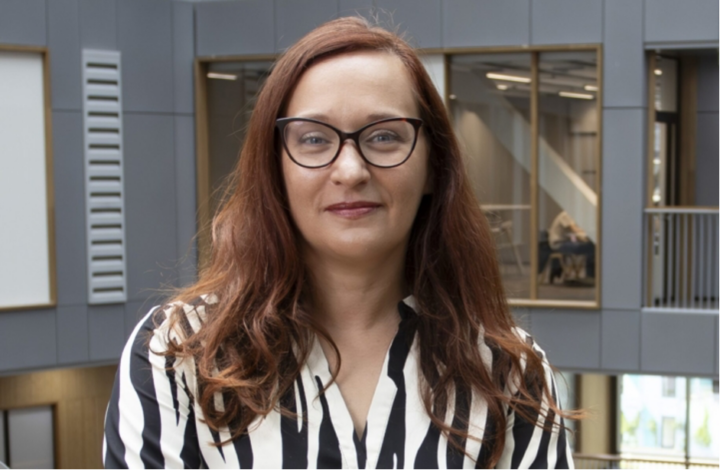
'Philosophy can be quite subversive': an interview with Catarina Dutilh Novaes
Catarina Dutilh Novaes is Full Professor in the faculty of Social Sciences and Humanities, Department of Philosophy at VU Amsterdam and Senior Research Associate at the African Institute for Epistemology and Philosophy of Science at the University of Johannesburg. As Distinguished NIAS Lorentz Fellow at the Netherlands Institute for Advanced Study in the Humanities and Social Sciences (NIAS) in Amsterdam, she is currently developing a novel conceptual framework to address the imprint of colonialism on scientific practices.
[Merlijn Olnon] How did you get here?
[Catarina Dutilh Novaes] I was born and raised in Brazil, with a two-year stint in France with my parents while in high school. I then studied philosophy and mathematics in Brazil (at the University of São Paulo) and then came to the Netherlands in 1999 for a Master’s in Logic at the University of Amsterdam. I’ve been in the Netherlands since, with a two-year period living in New York City in the mid-2000s. I did my PhD at Leiden University, and then had positions at the University of Amsterdam, University of Groningen, and now since 2018 at VU Amsterdam. I’ve worked on a range of different topics within philosophy and with an interdisciplinary orientation. My PhD was on the history of philosophy, more specifically on medieval logic. Since then, I’ve done research on history and philosophy of logic, philosophy of mathematics, argumentation theory, social epistemology, among others. I’ve been fortunate to get funding for large-scale projects from NWO and the ERC, and that also meant changing topics of research every so many years, since the funders want to fund novel research. I’m interested in a lot of different things, and philosophy is a great ‘place’ to be a very curious person.
[MO] What has been keeping you busy these days?
[CDN] Now, at NIAS I’m focusing on the topic of colonialism in science, which is a relatively new topic for me. NIAS is the ideal environment for the kind of exploratory research that is required when getting started on a new topic, and I’m very grateful for the opportunity. Recently I hosted the workshop connected to my fellowship at the Lorentz Center in Leiden, which was amazing! Inspiring people from Brazil, South Africa, India, Mexico, Chile, Canada, Australia (among others) all came to Leiden to talk about the entanglements of science with histories of colonialism and the lingering effects of those histories in scientific practices.
Another thing that has kept me very busy lately was the presidential election in my home country Brazil. We came very close to falling back in the hands of the Bolsonaro family, but through truly moving collective efforts, eventually Lula was re-elected. He’s a living legend, and while there’s something a bit frustrating in the fact that it took an eighty-year-old man to beat the Bolsonaros (the Brazilian left has not done enough in terms of succession lines), we are all very relieved! (Well, the half of the country that didn’t vote for Bolsonaro…) Despite being away from Brazil for so many years, I still feel viscerally connected to the country. It is also due to this combination of being born and raised in a former colony and living in a coloniser country for all my adult life that I am so interested in colonialism.
These historical entanglements between colonialism and science continue to have effects on how scientific research is conducted today.
[MO] Could you tell us something about your research at NIAS?
[CDN] The global European colonial expansion that started in 1492 has relied extensively on scientific knowledge both to support colonial enterprises—with ‘tools of Empire’ such as cartography, tropical medicine etc.—and to justify colonialism with the formulation of various pseudo-scientific arguments allegedly establishing the (racial and cultural) superiority of white Europeans. These historical entanglements between colonialism and science continue to have effects on how scientific research is conducted today, for example in the form of ‘helicopter research’: when researchers from wealthy, high-income institutions or countries travel to lower-income regions or marginalised domestic communities, collect data or knowledge, and leave without meaningful local involvement, equitable collaboration, or shared credit. And this is just one example: scientific practices and methods in general must be critically interrogated at a very fundamental level to reckon with these colonialist legacies.
Because I’m such a fan of science, I want to engage in this systematic reflection also to see how science can be reformed.
To be clear, I am not anti-science, very far from it! I take my flu shot every year and am very grateful for vaccines in general, despite the very painful history of systematic testing of unsafe vaccines in colonized regions. But precisely because I’m such a fan of science, I want to engage in this systematic reflection also to see how science can be reformed. I approach these questions as a philosopher of science and take inspiration from the work of feminist philosophers of science such as Helen Longino, Elizabeth Anderson, Lisa Lloyd and Alison Wylie. NIAS is a great place to conduct this research due to its interdisciplinary orientation and the many fellows working there beside me who are also interested in questions pertaining to colonialism. In fact, we are now hosting a weekly reading group on colonialism, and currently we are discussing the groundbreaking book Decolonizing Methodologies: Research and Indigenous Peoples, by Māori scholar Linda Tuhiwai Smith. So, I’d say it’s going well!
[MO] How does your current project relate to your previous work?
[CDN] I’ve worked on many different topics over my career, but I only started working more systematically on issues pertaining to politics and power in the last ten years—in fact, precisely during my previous stay at NIAS in 2016, when I was writing an ERC application to investigate the effects of power relations in argumentative processes. Spoiler: I got the funding, and the project then ran from 2018 to 2024. The book where I summarise the main findings of the project is about to come out, titled Reason and Power in Argumentation. But before that I was already very interested in feminism and philosophy of race (including teaching courses on the topic), and involved in anti-racism initiatives in the Netherlands, in particular activism against the traditional, racialised representation of the folk character ‘Black Pete’ (Zwarte Piet). A few years ago, with my team at VU Amsterdam, we had a reading group on Pedagogy of the Oppressed, an extremely influential book by Brazilian philosopher and educator Paulo Freire, in the context of the ERC-funded project on argumentation. After this experience, I came to realise that it was time to reconnect with my Brazilian roots more systematically in my research, and this is when I started developing my research interest in colonialism. I approach the topic primarily as an epistemologist and philosopher of science, so I’m particularly interested in the entanglements of colonialism with knowledge practices.
[MO] And to other disciplines and domains?
[CDN] My research has tended to be interdisciplinary from early on. When I was working on philosophy of logic, I engaged extensively with psychology of reasoning and cognitive science. When I was working on deduction (culminating in my book The Dialogical Roots of Deduction), I talked a lot with mathematicians and mathematics educators. For the argumentation project, the theoretical background was social exchange theory, which is a sociological framework inspired by anthropological research (Malinowski, Mauss). Now that I am working on colonialism, I am engaging systematically with scholarship from many disciplines, in particular literary and cultural studies, history, and the work of scientists who are already openly challenging the colonialist presuppositions in their disciplines, such as Brazilian archaeologist Eduardo Neves and Canadian environment researcher Max Liboiron.
[MO] Having worked on and around the topic for a while, what would you consider the most important new insights your research has brought to discussions about how to make science more equitable?
[CDN] In my research on the social epistemology of argumentation, I’ve focused specifically on argumentation in science. For example, in a co-authored paper with O. Çağlar Dede, I argued that the peer review system is not by itself able to redress the general bias against science that is not produced in prestigious institutions in the Global North. This is because the choices made by those in positions of power (journal editors, funding agencies etc.) will continue to reflect their own preferences and familiarities. In other words, science does not work as a large ‘marketplace of ideas’ where the best ones will prevail, no matter who proposes them; rather, those who are already in prominent positions will be much better placed to make themselves heard and engaged with. In practical terms, this means that we simply cannot trust the peer review system to redress these imbalances by itself; design interventions are needed to at least mitigate the effects of these biases, such as triple-anonymous reviewing processes for journals (when even the editor does not know the identity of the author).
More practically, in my own practice as an academic, I have found it particularly important to offer additional support to junior scholars at a disadvantage (be it due to gender, race, class, geographical origin, etc.); if this is not done, then the alleged ‘meritocratic’ system of science will continue to divert more resources to privileged groups. So, for example, for the Lorentz workshop of a few weeks ago, we made a point of inviting junior scholars and offering full financial support to them (and also to senior scholars from places where academia is less well-funded), among other reason to ensure their full inclusion in these scholarly debates.
Beyond my own teaching and research practice, I am currently the President of the European Philosophy of Science Association (EPSA), which also puts me in a position to implement interventions aimed at making our field more equitable. For example, we are now discussing the idea of making some funding available for underfunded philosophy of science associations around the world to organize their own events. As Europeans, we have the responsibility to address these inequalities that have emerged largely because of histories of colonialism.
[MO] What would you like to achieve through your work?
[CDN] In the big scheme of things, I think my most significant impact for ‘posterity’, as it were, will be felt in the people that I teach and train. As I’ve been in this business for many years now, it happens quite regularly that I run into former students who are now doing wonderful things (schoolteachers, editors, journalists and so on), and who tell me that the courses they took with me had an impact on their intellectual development. They remind me that education is really at the basis of everything. To give a concrete example: when teaching courses on philosophy of race years ago, the topic of Black Pete and the insidious but pervasive racism in Dutch society was extensively discussed, and I hope to have offered a valuable perspective to the many students who had never had the chance to reflect critically on these topics.
Of course, I also hope that my research as reported in my articles, books, interviews etc. will have the effect of prompting critical reflection. I like to say that philosophy is about questioning the obvious, showing that what seems obvious ultimately isn’t. Most institutions and socio-cultural structures are contingently constructed and can be revised if found to have undesirable consequences. In this sense, philosophy can be quite subversive, and as such can play a very important role in how we manage our social and political lives. I gladly take it upon myself the task of being subversive, of questioning the obvious.
Science does not work as a large ‘marketplace of ideas’ where the best ones will prevail, no matter who proposes them; rather, those who are already in prominent positions will be much better placed to make themselves heard and engaged with.
[MO] Having worked on and around the topic for a while, what would you consider the most important new insights your research has brought to discussions about how to make science more equitable?
[CDN] In my research on the social epistemology of argumentation, I’ve focused specifically on argumentation in science. For example, in a co-authored paper with O. Çağlar Dede, I argued that the peer review system is not by itself able to redress the general bias against science that is not produced in prestigious institutions in the Global North. This is because the choices made by those in positions of power (journal editors, funding agencies etc.) will continue to reflect their own preferences and familiarities. In other words, science does not work as a large ‘marketplace of ideas’ where the best ones will prevail, no matter who proposes them; rather, those who are already in prominent positions will be much better placed to make themselves heard and engaged with. In practical terms, this means that we simply cannot trust the peer review system to redress these imbalances by itself; design interventions are needed to at least mitigate the effects of these biases, such as triple-anonymous reviewing processes for journals (when even the editor does not know the identity of the author).
More practically, in my own practice as an academic, I have found it particularly important to offer additional support to junior scholars at a disadvantage (be it due to gender, race, class, geographical origin, etc.); if this is not done, then the alleged ‘meritocratic’ system of science will continue to divert more resources to privileged groups. So, for example, for the Lorentz workshop of a few weeks ago, we made a point of inviting junior scholars and offering full financial support to them (and also to senior scholars from places where academia is less well-funded), among other reason to ensure their full inclusion in these scholarly debates.
Beyond my own teaching and research practice, I am currently the President of the European Philosophy of Science Association (EPSA), which also puts me in a position to implement interventions aimed at making our field more equitable. For example, we are now discussing the idea of making some funding available for underfunded philosophy of science associations around the world to organize their own events. As Europeans, we have the responsibility to address these inequalities that have emerged largely because of histories of colonialism.
It happens that I run into former students who are now doing wonderful things [...] They remind me that education is really at the basis of everything.
[MO] What would you like to achieve through your work?
[CDN] In the big scheme of things, I think my most significant impact for ‘posterity’, as it were, will be felt in the people that I teach and train. As I’ve been in this business for many years now, it happens quite regularly that I run into former students who are now doing wonderful things (schoolteachers, editors, journalists and so on), and who tell me that the courses they took with me had an impact on their intellectual development. They remind me that education is really at the basis of everything. To give a concrete example: when teaching courses on philosophy of race years ago, the topic of Black Pete and the insidious but pervasive racism in Dutch society was extensively discussed, and I hope to have offered a valuable perspective to the many students who had never had the chance to reflect critically on these topics.
Of course, I also hope that my research as reported in my articles, books, interviews etc. will have the effect of prompting critical reflection. I like to say that philosophy is about questioning the obvious, showing that what seems obvious ultimately isn’t. Most institutions and socio-cultural structures are contingently constructed and can be revised if found to have undesirable consequences. In this sense, philosophy can be quite subversive, and as such can play a very important role in how we manage our social and political lives. I gladly take it upon myself the task of being subversive, of questioning the obvious.
This article originally appeared in Dutch in de Nederlandse Boekengids.