Who stands up for the freedom to be curious and ask uncomfortable questions?
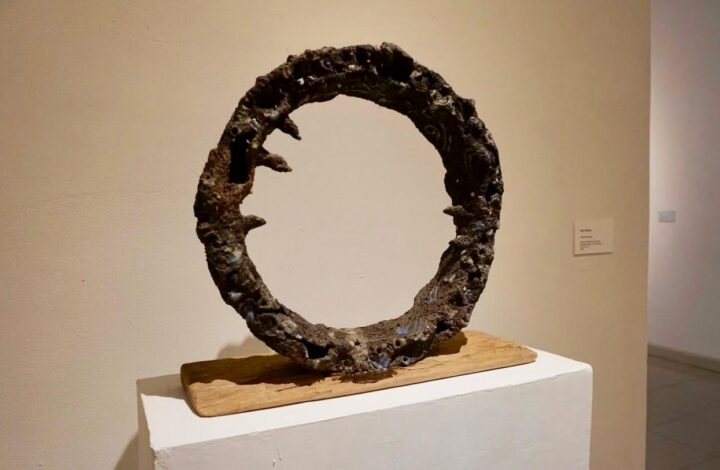
A doughnut studded with sharp spikes. Anyone who takes a bite risks tearing their throat open. This is the grim message of Donat Demokrasi, a ceramic artwork created in 1997 by Indonesian artist Noor Sudiyati in response to the murder of journalist ‘Udin’, who had exposed political corruption in Yogyakarta’s local press.
These were the final years of the authoritarian Suharto regime. For Sudiyati, the murder reflected the state of Indonesian democracy: a democracy that existed in name only, offering its citizens no real protection of their freedoms. To speak out was to risk one’s life. Just as taking a bite of the deadly doughnut could prove fatal.
Human rights
Three freedoms converge in this artwork: artistic, academic and journalistic freedom. Sudiyati is not only an artist, but also an academic with a PhD and a lecturer. Through her art, she condemned the murder of a journalist. These three freedoms spring from the same fundamental human need: the freedom to be curious, to ask uncomfortable questions, to challenge established truths and to imagine things that do not yet exist.
These freedoms are not privileges reserved for certain professions. They are protected by human rights and form part of the foundation of our democratic rule of law. But they do not flourish on their own.
Pressure
These freedoms are under pressure in the Netherlands, too. The Dutch Council for Culture recently warned of growing dependence on Big Tech, foreign interference, cyberattacks and legal intimidation. The Council has called for journalism to be recognised as a vital sector.
The situation is no different for artistic freedom. Earlier this year, the Council for Culture highlighted how artists face political interference, economic dependence and intimidation from society. Internationally, too, intimidation, censorship and political pressure are driving artists and performing arts institutions to impose restrictions on themselves.
Threatened
Restrictions on academic freedom are equally concerning. Scientists and scholars face threats when they share their expertise in public debate. Bureaucratic measures, funding conditions and budget cuts can restrict the scope for independent research.
In October, the Royal Netherlands Academy of Arts and Sciences (KNAW) published two advisory reports, on academic freedom and freedom of expression in academia, respectively. Among its recommendations, the Academy calls for stronger legal protection of academic freedom, preferably enshrined in the Dutch Constitution.
International research underscores just how essential such protection is. According to the Academic Freedom Index, academic freedom has declined significantly in fifty countries over the past decade, while only nine countries have seen improvements. Scholars at Risk documented 382 attacks on scholars, students and academic institutions across nearly sixty countries in a single academic year.
Kate Raworth
But what does it actually mean not merely to respect freedom, but to protect and promote it? To answer that question, we must return to the doughnut. Many will be familiar with Kate Raworth’s doughnut economics. Raworth describes the space between a social foundation and an ecological ceiling within which an economy can be both socially just and environmentally sustainable. What if we applied this idea to democracy?
The inner circle of this doughnut democracy represents the minimum requirements of a free society: the fundamental human rights that the state must respect. The outer circle marks the limits of our freedom. For freedom is not boundless: no one should be allowed to abuse their freedom to destroy that of others.
Interference
The government must therefore refrain from unjustified interference, while also actively protecting freedom against threats from others. Freedom requires both restraint and protection. Both circles must be safeguarded. Between them lies the space in which freedom can flourish.
The so-called trias politica, the separation of powers, plays an essential role in providing that protection in a constitutional democracy. But laws and institutions alone are not enough. We need only recall the Soviet Union and the fine guarantees of academic freedom enshrined in its constitution. Legal safeguards only acquire meaning when they are actively defended by people and institutions.
Universities must stand up for the freedom of their scholars and students. Editors-in-chief must protect their journalists. Arts institutions must give artists the freedom to create, even when their work provokes resistance. And they cannot always do so alone. Alongside the trias politica, we therefore need a trias civilis: an alliance of scholars, journalists and artists.
Imagining
Each of these three sectors contributes in its own way to exploring, questioning and imagining reality. And each has a stake in a society where the others, too, are free to pursue their work.
Scholars produce knowledge that journalists draw upon and make accessible to a wider public. Artists give expression to realities that cannot always be captured in facts or arguments. Together, they can bring to light what would otherwise remain hidden and hold those in power to account.
Sudiyati’s doughnut depicts a democracy in which exercising freedom becomes a matter of life and death. Doughnut democracy, by contrast, envisions a space in which that freedom is protected. It is up to us to ensure that the democratic doughnut never develops deadly spikes.