NIAS Studies in Academic Freedom and Epistemic Diversity
About the NIAS Book Series Studies in Academic Freedom and Epistemic Diversity
Institutes for Advanced Study occupy a unique place in the academic world. By bringing together world-class scholars and embracing disciplinary, epistemological and cultural diversity, they become powerful engines of new thinking. Places where unexpected comparisons spark and ideas cross-pollinate across fields and traditions.
The particular combination of advanced scholarship, freedom from institutional constraints and the liberty to venture into uncharted territory makes them ideal laboratories for reflecting on science and society, and for grappling with fundamental questions about academic freedom, epistemic diversity and the future of the knowledge system itself.
This series of monographs and edited volumes, published by NIAS with Leuven University Press, brings together insights from the institute’s fellows, alumni and partners, and is equally open to proposals from scholars beyond that network. Each volume addresses the structural challenges facing scholars, disciplines, knowledge domains and academic institutions as they navigate political, policy-related, economic and societal pressures. The series opens a conversation about where scholars and disciplines stand today, where we want them to go and what it will take to get there.
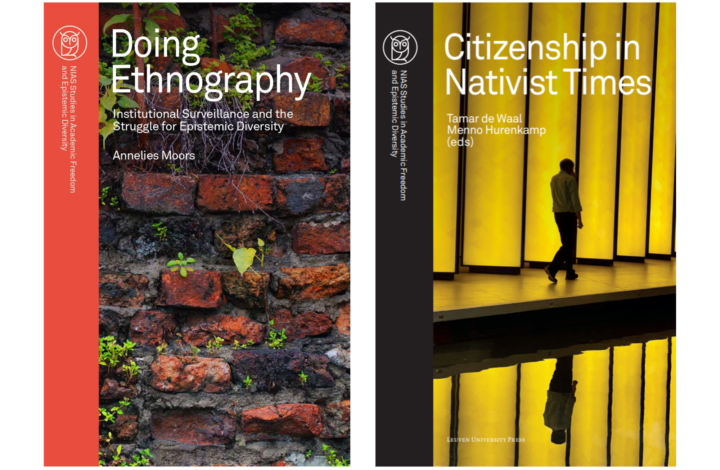
Volume 2: Citizenship in Nativist Times
by Menno Hurenkamp and Tamar de Waal (eds.)
Who counts as a real citizen — and who gets to decide? Over recent decades, debates about diversity, belonging and social cohesion have grown sharper and more urgent. Populist and nativist movements increasingly claim the power to define citizenship, often at the expense of democratic principles, the rule of law and the welfare state.
This edited volume takes those tensions as its starting point. Through case studies and theoretical reflections, contributions by leading international scholars examine how citizenship is being restricted, reimagined and reclaimed across its political, social, cultural and legal dimensions. From rights and representation to social welfare and public discourse, the volume maps the fault lines of contemporary democratic life — and asks what it means to belong in an age of deepening division.
Volume 1: Doing Ethnography
Academic research has come under growing institutional scrutiny over recent decades. This book traces the rise of ethical review procedures, open science mandates and integrity protocols, and examines how these developments shape ethnographic practice in concrete ways. It explores key tensions around informed consent, anonymity, researcher positionality and the sharing of field notes.
The book argues that contemporary academia tends to impose universal, bureaucratic forms of regulatory ethics — frameworks rooted in quantitative and positivist paradigms that sit uneasily with ethnography’s interpretive, immersive approach. In response, it calls for a situated, context-sensitive ethics of care that takes the specificities of ethnographic fieldwork seriously. At its core, the book is both a critical reflection on institutional power and a plea for the epistemic diversity on which academic freedom ultimately depends.
Annelies Moors is an anthropologist and professor emerita at the Amsterdam Institute for Social Science Research, University of Amsterdam.
Editorial Board
The editorial board consist of:
- Antoine Buyse, Netherlands Institute for Advanced Study (NIAS-KNAW) (editor-in-chief)
- Merlijn Olnon, NIAS-KNAW (editorial secretary & editor)
- Markus Balkenhol, Meertens Instituut – KNAW (editor)
- Jacob Boersema, New York University (editor)
- Nadia Bouras, Universiteit Leiden (editor)
- Karwan Fatah-Black, Universiteit Leiden (editor)