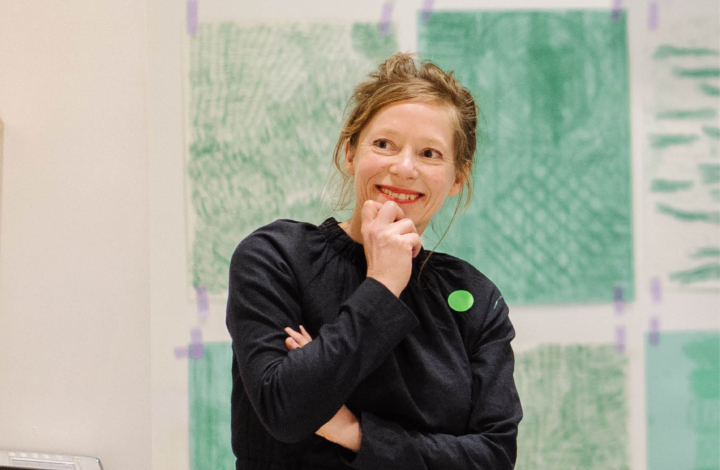
Interview with NIAS Artist-in-Residence Cecilia Hendrikx
23 June 2025In her practice, architecture is not merely a backdrop, but an active subject. “My work is about the physical environment of a building and what takes place within it,” she explains. “How does the logistics of such a place function? What do its users do, and what meaning can I read into that?”
I speak to the building first. The people connected to it follow naturally.
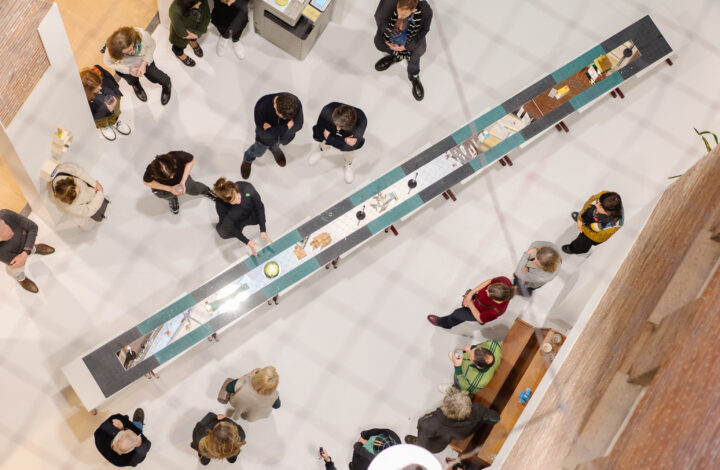
Contemporary ‘surtout de table’
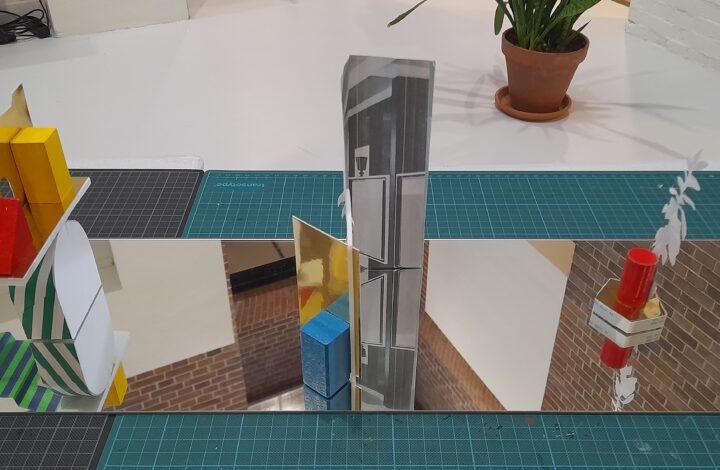
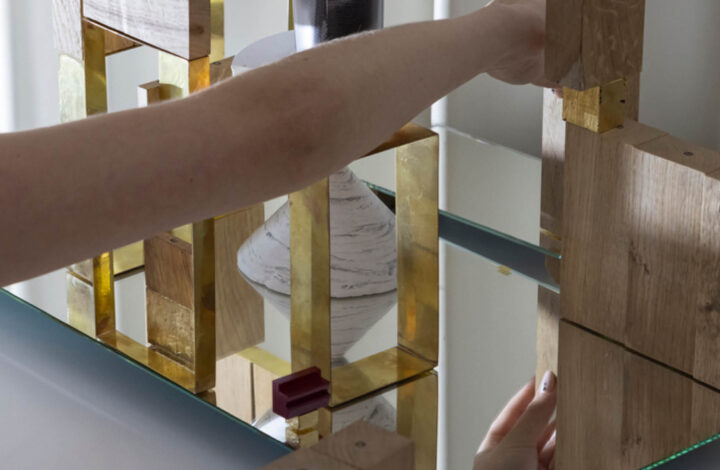
Hendrikx translates her spatial observations into sculptural table pieces inspired by the historic surtout de table. Traditionally placed on mirrored surfaces during formal dinners, these ornate miniature models—often of architecture—served both as decoration and conversation starters.
“Historically, the mirrors were used to reflect candlelight and illuminate the table,” she says. “But you also see yourself and the person opposite you in a different light.”
In her own work, mirrors remain the foundation. “It’s about reflection—both literal and metaphorical. I reflect something back to the environment and its people, but I’m also reflected in turn. That sense of reciprocity runs through my entire research process.”
Fascination with scale and form
What draws her so deeply to this form?
“It’s twofold. Firstly, there’s the surtout de table itself—it can take on endless forms. I find them fascinating, sometimes delightfully absurd. Creating a whole universe that fits on a table is something I really enjoy. These objects were never modest, but they always stayed within the physical limits of the table. I love that you can present something conceptually large—like the history of a building—in a tangible, contained way.”
Her background in architecture plays a vital role. “In architecture, we work with models. You can’t build the entire structure and then decide, ‘Actually, let’s go with brick instead of concrete.’ I’m comfortable working with scale and form.”
Listening to space before people
But there’s a deeper layer still: Hendrikx is ultimately driven by looking—by the act of observation.
“I studied architectural design. In that field, you focus on what a space is and how it comes to be. Starting with a space as the basis for my work feels natural. It’s my first language—before I even speak to people. I prefer to start by engaging with the building. Once I begin there, the people connected to it follow naturally.”
She describes a process of almost becoming the building. “From that position, I observe its history, its structure, how the systems within it influence each other—whether organisational, aesthetic, or social. These dynamics are embedded in the architecture.”
First Impressions and Slow Discovery
Hendrikx has not yet visited the NIAS building. How will she approach it?
“I like to wander through a building and notice what fascinates me. That might sound vague or intuitive, but it’s an important first step—before I learn anything about the building’s history or architecture.”
She focuses on what draws her attention, whether it’s a ceiling painting or the colour of the coffee machine. “You can’t plan it in advance—you let it happen. Afterwards comes the historical research and deeper investigation.”
Her artistic research often leads to conversations—with both people and place. “I talk to people who use the building about things I’ve noticed. It might be the plants or a detail in a hallway. It could also be a chance encounter.”
Her table pieces play an active role in this. “They help initiate conversation. During my five-month residency at NIAS, I plan to create a series—perhaps three table pieces for three different phases of the stay. I’ll introduce them gradually over the months.”
Visualising Patterns and Social Structures
Through her work, Hendrikx makes visible the hidden structures and relationships embedded in architecture. “Recently, I stayed in a modernist villa in Enschede, originally built for a textile-factory family. During the residency, the former nanny unexpectedly turned up at the door. The house had been designed with a nanny’s room—an architectural echo of social norms at the time. I created a performance around this table piece to reflect that history.”
Does her work always concern human relationships?
“It’s really about situations—about how people relate to systems, and to each other. About hierarchy and status, about formal and informal roles. And how those roles shift in meaning over time.”
Her work does not aim to deliver a moral or political verdict. “What I create isn’t a statement—it’s a universe. Anything can exist within it. That’s what I find both beautiful and sometimes quite funny. It’s really a metaphor for a specific place in a specific moment in time. And I think it’s valuable to have those, and to talk about them.”
More about the Artist in Residence Fellowship
More about Cecilia Hendrikx
This article previously appeared in Dutch on the website of the Akademie van Kunsten (Academy of Arts).
Text by Eliza Jordaan (Akademie van Kunsten), translated by Klaartje Laan (NIAS), photo’s by Almicheal Fraay and Peter Tijhuis.