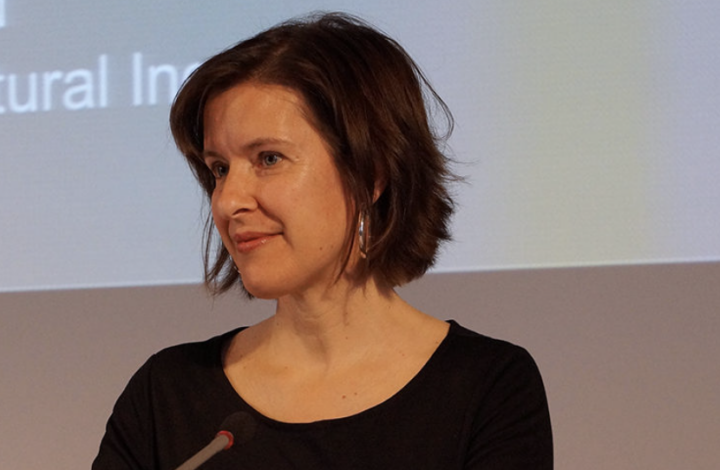
Community as ideal and practice: an interview with Tita Chico
The stories we tell ourselves
[Merlijn Olnon] How did you get here?
[Tita Chico] From graduate school up to the present day, I have been preoccupied by the stories we tell ourselves about our pasts and the stories that define how we make sense of the world around us. For me, this has recurred in an ongoing and evolving critical interest in the historicity of literary form—that is, thinking about what types of literature do, what metaphors and so forth do—and the history of ideas. For me, form—how something is told—and content—what is told—are always mutually constitutive and always in tension. When Jonathan Swift, for example, publishes A Modest Proposal for Preventing the Children of Poor People from Being a Burthen to Their Parents or Country, and for Making Them Beneficial to the Publick in 1729, a key part of the satire is that he uses the genre of the “proposal” written by a bureaucrat. That genre deepens the horror of the so-called solution—exporting Irish babies as food–because of its associations with seemingly dry governmental policy. Both the genre and the content come under fire.
On a personal level, I inherited my insatiable curiosity about art and society from my mother, an inveterate traveler and adventurer, as well as an historian. As a little girl, my favorite treat was being permitted to page through my mother’s art history books. And one of my most-cherished early photographs of us is her holding me at the opening of an exhibition on women’s history that she curated in 1972. I still learn from her—she’s nearly 95 now—and I open my book, On Wonder, discussing her response to an MRI a neurologist showed her after a stroke: “but that doesn’t explain what a thought is,” she announced.
I am currently Professor of English at the University of Maryland, located just ten miles northeast of the White House in Washington DC. I teach undergraduate English majors and graduate students pursuing MAs and PhDs, mostly in eighteenth-century British literature, but also in theory. I’ve also recently developed a course on detective fiction for undergraduates who are not English majors, which has been a terrific opportunity to teach a genre that thematizes problems of interpretation, identity, and social norms. On campus, I have also held a variety of administrative posts (dean, director of the Theory Certificate, director of graduate studies, director of a center) and served as president of the campus faculty organization.
For my students and my communities, I refuse to cede hope in a better future.
Collective Futures: Community, Technology, and the Work of Hope
[MO] What is occupying you these days?
[TC] My most pressing concerns are borne out of hope for my students and my community, and out of worry about the damage my country’s government inflicts nationally and globally. These concerns take the form of two related questions: how to be in community and how to cultivate just communities. For me, my professional and personal lives converge around precisely these questions. What does it mean, particularly in this time, to cherish community as an ideal and—often the thornier issue—as a practice? I’ll give two examples of how I try to do this, one professional and the other in my personal life.
As Director of the University of Maryland’s Center for Literary and Comparative Studies for several years, I hosted more than 100 speakers and welcomed some 7,000 attendees to scholarly programs focused on literary study as promoting and variously enacting antiracist teaching and research. But to do this work and to do it well requires reimagining how organizations function. How one goes about this work matters as much as the fact that one does it. My colleague and friend, Zita C. Nunes, makes the powerful point that just scooting over to make room for new voices merely reproduces the same structures. The challenge is to reimagine much more fully what might be.
But I also live in Washington DC, a city bereft of representation in Congress (the District of Columbia does not have any voting members of Congress). My civic work has been related to gathering with neighbors and friends to speak truth to power. In practical terms, this most often means getting on the Metro and going down to protest at the Capitol, White House, or Supreme Court. It has also meant canvassing for political candidates and accompanying “undocumented” residents to their government appointments. As for the latter, I am currently abroad and have not done this work since my government’s unleashing of often illegal deportation tactics. Occasionally, it has meant getting arrested by the Capitol Police for civil disobedience. But the point is this: for my students and my communities, I refuse to cede hope in a better future.
[MO] What is occupying you these days?
[TC] My most pressing concerns are borne out of hope for my students and my community, and out of worry about the damage my country’s government inflicts nationally and globally. These concerns take the form of two related questions: how to be in community and how to cultivate just communities. For me, my professional and personal lives converge around precisely these questions. What does it mean, particularly in this time, to cherish community as an ideal and—often the thornier issue—as a practice? I’ll give two examples of how I try to do this, one professional and the other in my personal life.
As Director of the University of Maryland’s Center for Literary and Comparative Studies for several years, I hosted more than 100 speakers and welcomed some 7,000 attendees to scholarly programs focused on literary study as promoting and variously enacting antiracist teaching and research. But to do this work and to do it well requires reimagining how organizations function. How one goes about this work matters as much as the fact that one does it. My colleague and friend, Zita C. Nunes, makes the powerful point that just scooting over to make room for new voices merely reproduces the same structures. The challenge is to reimagine much more fully what might be.
But I also live in Washington DC, a city bereft of representation in Congress (the District of Columbia does not have any voting members of Congress). My civic work has been related to gathering with neighbors and friends to speak truth to power. In practical terms, this most often means getting on the Metro and going down to protest at the Capitol, White House, or Supreme Court. It has also meant canvassing for political candidates and accompanying “undocumented” residents to their government appointments. As for the latter, I am currently abroad and have not done this work since my government’s unleashing of often illegal deportation tactics. Occasionally, it has meant getting arrested by the Capitol Police for civil disobedience. But the point is this: for my students and my communities, I refuse to cede hope in a better future.
There is no longer a shared consensus of reality.
Devices of Enlightenment
[MO] Could you tell us something about your research at NIAS?
[TC] My interest in epistemology and literariness has developed into an ever-deepening fascination with the multiplicity (and multiplying) entanglements of literature with what we now understand as science and technology. The book I am writing at NIAS, Devices of Enlightenment: A Literary History of Technology, comes out of these interests. It also responds to a deep hunger in my classrooms and communities: the desire to understand the implications, large and small, of what technology has meant, does mean, and can mean. So many conversations, whether in the classroom or with colleagues or with my various communities beyond campus, are often laced with urgencies prompted by the latest headline about artificial intelligence, for instance, heightening policing and surveillance, or threatening knowledge work and labor markets. I think one of the main issues coming out of these technological changes, and one that challenges us collectively, is particularly damaging, namely that there is no longer a shared consensus of reality.
I can imagine that readers might wonder what any of this has to do with the eighteenth century. One of my primary discoveries is that concerns about technological change are hardly new, in no small part because they bring to the surface pressing and persistent questions about who “we” are and what our relationship to the world might be. For example, thermometers in the eighteenth century were designed to represent temperature, but we see in their development lots of problems and questions about what a scale of temperature might be. During this time, there were upwards of twenty different scales used throughout Europe, a particular challenge when observers tried to compare the depth and duration of what was called Le Grand Hiver (the “Great Frost” in English) of 1708/09, which brought three months of unbearable cold to great swaths of Europe. Le Grand Hiver is an example of “climate disruption” during “the Little Ice Age” (c. 1300-1850). Beginning in the eighteenth century, Daniel Gabriel Fahrenheit’s scale gained favor, particularly in the Anglophone world, until the 1970s. Fahrenheit, of course, set up an instrument shop in Amsterdam in 1714 and lived in the city until his death in 1736. Looking back now, Fahrenheit’s scale is interesting and provocative because it marked three points: frozen, boiling, and “body temperature.” The first two refer outward, to a natural phenomenon. But the third turns to the human. And in this turn, Fahrenheit defines “body temperature” as that of a healthy, western man. Understanding Fahrenheit’s scale, and the assumptions upon which it is based, allows us to recognize that it implicitly supported what later comes to be “race science” that views non-western, raced and gendered bodies as physiologically different. This is a matter of representation and world making, precisely the sorts of things that I study in my book.
I use the term “device” to describe these objects and representations for a few reasons. A device is an object; as such, it may be a physical item or something discursive (I have discovered “language machines” that take the form of tables). A device is a process with a duration—there is a beginning, a middle, and an end. And a device points to a future after its use. I am inspired by Kate Crawford’s conclusion to The Atlas of AI: Power, Politics, and the Planetary Costs of Artificial Intelligence in which she argues that our collective next step is not merely accountability, but instead a radical politics of refusal, rejecting the supposedly neutral levers of power that manage our existence. What matters greatly to me is that devices (as they do now) give shape to new ideas about humanity and new forms of social relations across space and time.
I hope that my scholarship on Enlightenment devices helps us to understand what has happened in the past and what we might imagine for our collective futures. To pause for a moment to address my use of the term, “collective futures”: I think that intellectually and socially seemingly individual approaches are so easily rewarded, when, in fact, I believe that we rise and fall together. This is not—at all—about conformity. I think the great lie about individualism is that it is the antidote to group think; both approaches are impoverished. Difficult and uncomfortable thought and action are necessary for collectivity, be it in the service of improving institutions or labor conditions. And collectivity is at the heart of intellectual work. Our research is in conversation with those before us and speaks to our peers and students, as well as to those coming after us. I may work quietly on my own hunched over a book or a keyboard, but I am never alone.
NIAS is an ideal forum for me to research and develop these concepts and ideas. Not only does NIAS provide a vibrant, multidisciplinary environment, but also a community of international scholars in regular conversation.
Inherited frameworks
[MO] How does your current project relate to other disciplines and domains?
[TC] Given the historical nature of my archive, my work is mutli-disciplinary, as the “disciplines” as we now understand them did not emerge until the nineteenth century. Within a contemporary intellectual context, my scholarship uses the methodology of literary criticism—close reading of technological, scientific, and literary archival (primary) sources in critical conversation with theoretical, historical, and conceptual (secondary) sources. I develop these close readings what Lisa A. Lowe characterizes in The Intimacies of Four Continents as the “intimacy” of modern, Western liberalism and the global conditions upon which it depends. Lowe urges us to look at such “scenes of close connection in relation to global geography that one more often conceives in terms of vast spatial distances.” My work also brings together the scholarly fields of literature and technology, the history of scientific instruments, and science, technology, and society studies, particularly feminist and post-colonial approaches to Science, Technology, and Society Studies.
[MO] And to your previous work?
[TC] As a scholar of long eighteenth-century British literature, with a particular focus on literature, science, and technology, my eye is particularly attuned to the historical moment we might consider “pre-disciplinary.” This is a time when the configurations that shape our current academic and intellectual landscapes did not exist.
Science is often imagined as a progressive victory of discovery, innovation, and success, with requisite misfires that can fortuitously lead to greater insight. Although there are ample instances in modern life—say, climate change—that reveal the shortcomings and mystifications of this story of ours, it can be difficult for us to “unthink” the notion that scientific and technological discoveries yield new approaches to the mysteries of human existence, improve and expand daily life, and point culture towards an ever-promising future of greater discovery and advancement. What the narrative of progression also misses is how science and technology operated (and operate) not only as an epistemology and praxis that demand our renewed critical attention, but also as a set of relations that organize people and institutions. This is why the imaginative work of literature is key to understanding what science and technology were and can be.
Imagining our futures
[MO] What would you like your work to achieve?
[TC] I hope my work teaches us that our contemporary preoccupations have a long pre-history. John Wilkins, in the seventeenth century, imagined a universal language, Francis Lodwick, a universal alphabet. Fredrich Knaus’s eighteenth-century “Allesschreibende Wundermaschine” positioned a quill in a miniature hand that wrote on paper. Some of these language machines were designed to automate and instrumentalize language, with the idea that reducing linguistic ambiguity would also limit political factionalism. All of these language machines challenged seventeenth- and eighteenth-century audiences to reimagine what human expressivity was, a confrontation not dissimilar from the current anxiety about Large Language Models such as Chat-GPT. This is not merely to say that nothing is “new,” but instead to think about our present moment as part of a longer historical arc. I see us now as in a period that began emerging in the European eighteenth century with major shifts in science and technology, capitalism and saltwater slavery (I use Stephanie E. Smallwood’s term), politics and media. Joseph Roach, Eugenia Zuroski, and others make the point that what emerged then in the eighteenth century continues to persist. And Zuroski reminds us, in a formulation that I find especially powerful, that “no one else knows just how long the ‘eighteenth century’ has been in quite the same way as Indigenous and Black communities in the settler colonial nation states established in that period. It’s a century that refuses to stop.”
My hope is that my research creates space for others to cultivate the new ideas that will take our field and profession, our students and our communities into a productive future.
I’ll also evoke my concluding sentiments from my book, On Wonder, for they continue to guide me. I see wonder as an object, as a feeling, as an invitation to study, and as a way of thinking. It is at the heart of natural philosophical inquiry in the long eighteenth century, and it requires observation and imagination. Perhaps most radically, I argue, wonder allows us to engage what Katherine McKittrick in Dear Science and Other Stories describes as “the difficult work of thinking and learning across many sites, and thus coming to know, generously, varying and sifting worlds and ideas.” My hope is that my research creates space for others to cultivate the new ideas that will take our field and profession, our students and our communities into a productive future.
I’d like to plug the forthcoming work of some colleagues that is especially exciting for just these reasons. Patrícia Martins Marcos, an historian of science, is writing a terrific book on how the early modern concept of race in Portugal and its Atlantic colonies was “scientific,” drawing upon Greek medicine, Aristotelian natural philosophy, Christian theology, and Roman law. Kristina Huang, trained in literary studies and critical race studies, is at work on a great book that centers historical representations of subaltern, enslaved, and minoritized lives in the eighteenth-century Atlantic world, using their representations as the starting point to reimagine critical theory and political practice. And Allison Gibeily, also working in literary studies, is finishing a wonderful PhD dissertation on embodied and oral literary practices in eighteenth- and nineteenth-century Arabic travel writing. Taken together, these scholars affirm the intellectual and research possibilities of Lowe’s concept of “intimacy” that I describe above. Such routes are particularly promising for eighteenth-century studies.
[MO] What are your thoughts on how influential this kind of literary-historical scholarship can be, by what routes, and on what timescale?
[TC] I am at once cautious and ambitious about such questions. The violence of state actors and the complicity of financial institutions—in the time of this interview, so many people are being murdered and displaced, enduring unimaginable horrors. Does my work help with any of that? It cannot possibly.
And yet. To think about higher education is a slightly narrower purview. In the United States, so much about education has been attacked, belittled, defunded, even criminalized that those coming after me have a darkened future—fewer job prospects and less security in countless ways. Within this context, my colleague and friend, Professor Lisa M. Moore, recently published an op-ed in which she documented the scores of ways the University of Texas was being destroyed. The misery and damage are profound, and the effects will be long-lasting. And yet. Lisa gives us a gift with her concluding words:
like the medieval monks and nuns who buried precious manuscripts to hide them from the kings who burned their abbeys, we will preserve this knowledge and progress for another time in the future. In the meantime, we know the truth, and that keeps us free.
I hold on to Lisa’s words for their integrity and their vision.
And yet—and this is key—this does not make such work unimportant. Instead, these contexts make it absolutely vital that humanistic work be carried out by many of us, in all the ways that might be possible. We need history and imagination. We need culture and research. These are the things that feed us the stories we tell about ourselves. These are the things that help us to understand the world around us, both as it is and as it could be. Another colleague and friend, Kandice Chuh, uses the phrase “imagine otherwise” to talk about acts of world making. So, I share her wisdom, too, to ask, and to ask with hope and determination: how and what can we imagine otherwise? What radical acts of world making can we dream up? Taking up these questions and holding them dear—this, I believe, is how we can shape our collective future.
We need culture and research. These are the things that feed us the stories we tell about ourselves. These are the things that help us to understand the world around us, both as it is and as it could be.
This interview was conducted by Merlijn Olnon and originally published in de Nederlandse Boekengids.