Transcript Room to explore, podcast 4: Nothing
Introduction
Annick van Rinsum
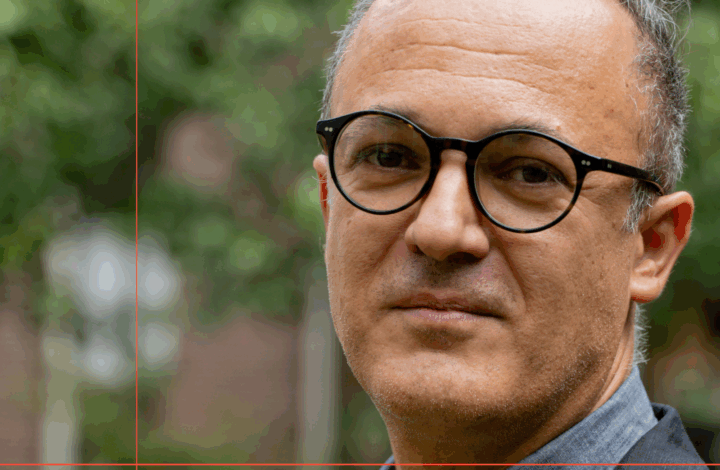
Welcome to this podcast by NIAS, the Netherlands Institute for Advanced Study in the Humanities and Social Sciences. A place for researchers to find the time and space to fully pursue their curiosity and ask new questions. My name is Annick van Rinsum and in this episode I’ll be speaking with Aleksandar Bošković. He’s a scholar of Russian and European modernism, Yugoslav and Balkan studies, with a strong background in comparative literature, critical theory and visual studies.
In his research project, Nothing made in Yugoslavia, he looks at how, at the core of experimental art practises from the former Yugoslavia, is a compelling idea: that Nothing can help us rethink how value is created.
Podcast
Aleksandar Bošković
History as we know it—and society as we experience it—are human inventions that we often take for granted. Behind it is one big nothing. I hope we did not come into this world merely to accumulate wealth and reduce our purpose to that alone. But that we are part of a bigger discussion.
Annick van Rinsum
Welcome to the NIAS Library.
Aleksandar Bošković
Thank you. It’s a pleasure to talk to you, first of all, and I’m really honored to be a part of your podcast.
Annick van Rinsum
Can you tell me a bit about your research?
Aleksandar Bošković
My research is tentatively called Nothing Made in Yugoslavia, and maybe the best way to explain it is to start with an anecdote from the Buddhist tradition. It’s about a master whom a young disciple kept pestering with endless questions: What is the most important thing in the world? What is the value of all other values? What is the greatest good? One day, the master gave him a short answer: “It’s a dead cat.”
After a long silence, the disciple—completely confused—stood there thinking, What is this answer? The master, breaking all conventions, explained himself briefly: the dead cat is the most valuable thing which determines all other values, precisely because its own value is indeterminate. This paradox lies at the heart of my project.
I’m looking at experimental art practices across different media—literature, visual culture, film—practices that revolve around questions of nothingness, emptiness, silence, negation, but also anonymity, authorship, copying, and even the entropy of representation. Just like the dead cat, these artists pushed back against all systems that try to measure value—whether that’s the state, ideology, art institutions, money, or even language itself.
I’m studying artworks spanning from the 1920s and the historical avant-gardes, through the 1960s and 70s with experimental film and conceptual art, all the way to the 1990s and 2000s in the era of postmodernism. I focus on artists who turned to nothingness as a strategy to express decolonial aesthetics and radical epistemology. Examples include subtracting zeros from banknotes, writing a book made entirely of quotations, or even works praising laziness.
What all these works have in common is that they reveal how the invisible, indefinite, and inaccessible—or the nothing—resists conditioning, manipulation, and exploitation, opening up, in a way, a space of freedom. That, in a nutshell, is my project.
Annick van Rinsum
And if we go back to the example the teacher gave—the dead cat—could you explain that further? How can we use this dead cat to understand value, or even to deconstruct it?
Aleksandar Bošković
Yes, it very much belongs to a category that remains open to interpretation and prompts us to ask questions—and eventually arrive at different answers. I would say that both my project and the phase I’m in now are more focused on generating those questions than on providing answers. One of the things this dead cat—or nothingness—can help us with is defining what is truly important for any democratic subject.
Annick van Rinsum
Please explain.
Aleksandar Bošković
For example, one of the artists I’m looking at in my research argues that this dead cat—or nothingness, or what he calls the infinitive, or the highest value of all—is something we, as humans and as societies, have largely forgotten. We’re not used to living in a state of uncertainty; humans like certainty, right? So we end up accepting definitions of this nothingness, of this so-called infinitive.
The problem is that these definitions become what he calls definitives. Any attempt to define the infinitive—the inaccessible, invisible dead cat—turns it into a definitive. And these definitives are not the highest values. Yet because we crave certainty, we mistake these definitives for infinities. We treat them as the ultimate values, whether that’s a homeland, the idea of a particular God, or societal values like civil rights and so on.
Annick van Rinsum
So, does it really matter that the teacher used the example of a dead cat? Or could he have used something else entirely?
Aleksandar Bošković
Obviously, he could have used anything else that is valueless, because this Zen story expresses the same idea found in ancient philosophy—namely, in Aristotle’s Nicomachean Ethics, which is about morality. There’s a story about a friend of Aristotle’s son, whose name was Eudoxus, known in philosophy as Eudoxus’ paradox.
To explain it briefly: in order for something to have the highest value, it cannot be measured or evaluated by anything else. The highest value itself becomes the evaluative principle, which cannot be evaluated – so, in a sense, it is valueless. That’s much like the dead cat; it’s a good example of the concept, right?
This idea is very inspiring for thinking further about what definitions or definitives it may have. As the author of the book I’m looking at points out, not all definitives are created equal—some definitions of the infinitive are much closer to the infinitive itself.
Annick van Rinsum
Such as..
Aleksandar Bošković
Take, for example, masterpieces of art—true masterpieces. If we think about literature, a masterpiece in literature is probably something that cannot be retold. The reason is that the use of language—the very way of expression within that work—is what makes it a masterpiece.
So, if we wanted to copy that masterpiece, we would have to replicate it exactly, down to the last detail. This is what Pierre Menard does in his story. He becomes, in a sense, the “real author” of Don Quixote by recreating Cervantes’ work word for word.
This idea is similar to what Borges discusses. He uses it to explore concepts like the relationship between definitives and infinitives. There is a sort of “distance” between a definitive – which is a definition of something finite – and infinity, which is, by nature, indefinable. That distance can be large or small. According to this philosophy, the smaller the distance, the better.
Annick van Rinsum
How do we place the dead cat and masterpieces of art in this scale?
Aleksandar Bošković
Yes. So they come close to each other because…
Annick van Rinsum
Because then the dead cat represents something valueless. In a masterpiece of art is something we supposedly value a lot, so, but they’re also kind of this in the same category.
Aleksandar Bošković
Exactly. Exactly because the dead cat is just a metaphor for the highest value. Does that make sense?
Annick van Rinsum
It does, and it doesn’t—at the same time. And, I suppose, that’s the point.
Aleksandar Bošković
Yes, yes, yes. It’s the ambiguity—or rather, the inability to define it—that makes it so valuable. And the same goes for masterpieces of art. There’s a wealth of literature, scholarship, analysis, and interpretation written about them, yet they continue to inspire people to write. They remain more valuable than everything written about them.
Annick van Rinsum
So, when in your life did it click that it might be more interesting to ask questions, to sit with confusion and ambiguity, rather than constantly search for answers or definitions?
Aleksandar Bošković
I’m trained in literary scholarship, but I’ve always been interested in other art forms, specifically film and visual culture. While I was working on my previous project—an anthology of the Zenithism, an autochthonous Yugoslav avant-garde movement from the 1920s—I tried to tell a slightly different story about that movement than what had been known so far.
I co-edited this book with my co-editor, Steven Teref, who is a poet and translator, and we kind of looked at it and decided to translate in this anthology 14 chapbooks which were published by this Zenithist Press instead of translating only texts from their well-known journal called Zenit.
The usual story about this avant-garde movement is primarily connected to their notion of the “barbarogenius”: the idea of an original, artistic figure from South Slavic culture who draws from local sources to revitalise tired European culture. It’s somewhat reminiscent of Italian Futurism, if you’d like. Another idea pushed forward by Zenithists was the “Balkanisation of Europe,” the belief that European culture had become ossified and mechanised, and needed new forces. The newly formed Yugoslavia—then called the Kingdom of Serbs, Croats, and Slovenes—was seen as such a force, capable of generating new forms in art.
That was the standard narrative about Zenitism. But by translating these chapbooks, we aimed to show that they frequently engaged in cross-genre writing. This wasn’t unique to Zenitism, but they took it to such an extent that it became a defining feature for them. That, I would say, is one of the key contributions of our ontology.
Within these experimental, cross-genre writings, we also discovered works that were lesser-known – or almost entirely unknown – even in the former Yugoslavia. These date from 1925 and 1926 and are by a completely obscure writer called Mita Dimitrijević, known by his pseudonym MID. One book is titled Sexual Equilibrium of Money, or The Trade Correspondence on the Currency Question, and the other is simply called Metaphysics of Nothing. These books are very strange—you really cannot pin them down in terms of genre.
Annick van Rinsum
They’re a bit reminiscent of the manifestos of Dadaism, if you take a close look at them.
Aleksandar Bošković
Exactly. You had a chance to look at the translations—they do. They also have quotes from Surrealism. They have empty pages, plus and minus signs printed on the pages in different colours. They include a form of dialogue between something called the First and the Second. Within them, there’s also A Smallest Anthology of the Tiniest things.
They have references to history, philosophy, artists, writers, even politicians contemporary to their own time—the 1920s. They deal with the concept of value, and also with the concept of nothingness, treating it as something that should be included in the standard for measuring value—whatever the standard is. Usually, that standard refers to money itself. But they also refer to the philosophical problem of the duality of metaphysics and trying to overcome that duality.
They are kind of quasi-philosophical treatises, different from the usual form of manifestos because they have some narrative coherence, although they are very thematic and it is hard to probe into those texts. The other book looks like a sequel to the first one and even repeats some of its writings. Both books are made up of quotes, quasi-quotes, and invented quotes— before Borges started writing, or long before postmodern strategies of intertextuality and mystification of sources came into play.
Both of us were amazed by these books. They reminded us of other works I read from the 1990s in Yugoslav art and literature – like the book about Infinitive by Sreten Ugričić, writer and philosopher. These early Zenithist books also resonated with conceptual and visual artists such as Mladen Stilinović, a Yugoslav and Croatian visual artist who played with banknotes—euros, dollars, dinars—and asked questions about value, how we evaluate things, and played with language, especially ideologically charged language of socialism. Another artist, Goran Ðorđević, worked with the notion of copying, questioning authenticity and originality.
The same notions are questioned in the Zenithist books. These two books do not have the author’s name on the cover; we identified him through the two texts he published in Zenit and two reviews of his books that named him directly. The story we tried to change with this anthology is that, instead of seeing Zenithism as an avant-garde movement bringing something authentic and original to European avant-gardes, these two books end up questioning the very notions of authenticity, originality, and even authorship – as the very premises on which colonial domination and Western cultural authority rest.
In that sense, they are very decolonial, and this is something they share with the art production that came later.
Annick van Rinsum
So in a way, they reject authenticity, but they do it in such a way that they become authentic.
Aleksandar Bošković
Exactly, that’s well said. And that’s maybe the same paradox that makes them more interesting than if they were one-dimensional. This duality—or ambiguity—is both a topic and a characteristic that these works try to deconstruct and overcome.
Annick van Rinsum
And so, these works ring a lot of bells, in your words. But something that comes back is also in the title of your project: Nothing. Why does this remain the overarching theme of your project?
Aleksandar Bošković
Yes, that’s also interesting—and a good question. So, nothing is a concept that is very productive when thinking about this type of work. Throughout all of them, there’s some form of an inaccessible, indescribable core – an attempt to articulate emptiness, the void, silence, the entropy of representation, and so forth.
Maybe the best way to answer your question is to talk a little more in detail about one of the books from the 1990s I mentioned, called Infinitive, and also to connect it to other concepts such as money, zero, copy, and negation. I know this sounds a little abstract, but I’ll do my best.
Annick van Rinsum
Let’s go ahead and do that.
Aleksandar Bošković
So, this book, Infinitive, is a monograph about the philosopher Stephen W. Greenchurch, an American philosopher who wrote a three-volume work published by Cambridge University Press called The Axiological Infinitive.
In Infinitive, the writer and philosopher Sreten Ugričić writes, in part, about the main concepts of Greenchurch’s philosophy. As I said, the central idea in his philosophy is this concept of the infinitive, which is inaccessible and indefinable—a bit like a “dead cat.” It is able to give value to everything else because it is, in itself, the highest value.
Another concept that Ugričić discusses in his book is Greenchurch’s notion of the definitive, which is the definition of the infinitive. He also develops the concept of “not the best.” He argues that it’s not very useful to say something is good, better, or the best. It’s more productive to say that something is “less bad” or “the least bad.”
In this framework, “bad” is not just an adjective, like worse or worst—it’s also an acronym: BAD, which stands for Basic Axiological Difference. This refers to the difference between the infinitive, the highest value, and the definitive, its definition. If the distance between the infinitive and the definitive is the closest, or the least distant, then that is the best. That, for example, is what defines a masterpiece of art.
Annick van Rinsum
And why again, would that be the best outcome?
Aleksandar Bošković
It comes closest to the infinitive itself, which, as we know, is inaccessible. We cannot reach it directly, but we can come close to it.
Annick van Rinsum
But if it’s inaccessible, what is interesting about striving to become close to it?
Aleksandar Bošković
According to Greenchurch, it’s very important to remind ourselves of the existence of the infinitive, so that we are not conditioned or manipulated by any other definitive. For example, in the 1990s, this idea resonated politically, because it served as a critique of ethnically oriented nationalism that fuelled the wars in the former Yugoslavia. Such nationalism functioned as definitives that people took for infinitives.
According to Ugričić, Greenchurch’s concept of the infinitive is very important because it reminds us not to fall into the trap of all sorts of definitives that exist in our societies. If that makes sense.
Annick van Rinsum
But can we ever? Or, how can we ever know if it is the least bad? Nobody can give us a definitive answer on that either, right?
Aleksandar Bošković
That is a question that all of these artworks I’m looking at, are trying to answer, and there are many and plenty of answers: “least bad,” “less bad,” and so forth. Some of these artworks directly targeted the art system within which they operated. For example, the New Yugoslav Practices movement in the 1960s and 1970s disregarded the idea of the autonomous art object and tried to present art more as a process, opening it up to all sorts of people—not just those who called themselves artists.
There are also examples where people criticised elements of the art system that perpetuate dominant hegemonic discourses, such as galleries, exhibition spaces, and museums. They took the artwork outside these institutional constraints – onto the streets, into parks – and, in doing so, attempted to dematerialise the artwork. This is a well-known notion of conceptual art, turning art into a procedural or temporal event rather than a fixed object.
Then there are examples of experimental film, which in Yugoslavia could be called “anti-film.” Very early proto-structuralist films from the 1960s positioned themselves as theoretical films, exploring the limits of their own medium: what film is, how language works in film, and what the limits of filmic representation are. These are sometimes called fixation films, because they were made with the idea of representing the entropy of representation. Some were shot without intervention from the author – the camera would be fixed on the back while the filmmaker walked through the streets, or the film would be fixated on one scene letting life happen in front of it.
These films ask the same questions: how do we know if we are close to the infinitive or not? They are self-reflexive artworks that reflect on the limits of their medium. Another interesting aspect for my project is that these works are always very much about the medium itself. Whether literature, visual culture, film, or radio, we encounter glitches, imperfections, and “noise” in the communication system, which become central for artists exploring the limits of their medium.
To go back to your question about nothingness: in the book I mentioned, Infinitive, nothingness functions as a sort of meta-sign. This is important because the entire book by Sreten Ugričić is about Greenchurch’s Axiological Infinitive. However, neither Greenchurch nor his book actually exist – they are a complete fiction. Yet the concept of the infinitive in Ugričić’s book talks about a book that is impossible without the book itself. There’s a paradox here. In a way, Greenchurch’s Axiological infinitive becomes a meta-sign. In Ugričić’s Infinitive, it exists both inside the book as a concept and outside it, functioning as a philosophical term. The book is trying, in its own way, to come close to the infinitive.
Annick van Rinsum
And is the use of a meta sign, again, a way to get closer to the Infinity?
Aleksandar Bošković
That’s a good question, and that may be the answer—or at least, conceptually, it’s very useful to think about it that way. For example, Sreten Ugričić writes that if his book were about a mathematical problem, it would be called Zero. And when you think about zero, it’s the same thing in conceptual terms: it connects to other signs within the syntax of numbers.
Zero is, at the same time, a cardinal number—like one, two, three, and so on. But within cardinal numbers, zero represents the beginning, the origin of counting. Without zero, I couldn’t count further. And when you think about ordinal numbers—first, second, third, fourth—zero becomes a sign for an order that can extend infinitely.
Annick van Rinsum
Because is a starting point…
Aleksandar Bošković
Because it is the starting point, and at the same time zero exists inside the number system like any other number. But from outside the system, it represents this kind of empty plurality—there is nothing, right? Zero is essentially nothing. So it has this dual feature. It is also a meta-sign. That’s why Ugričić says this is what his book would be called if it were written in mathematical terms.
A similar thing happens with money in the history of money. Once zero as a number—originally a Hindu concept—comes through Arabic cultures into the European context, very much via Mediterranean trade, Venice, and later international trade in Amsterdam, it becomes central to the origins of capitalism. There are many books written about this, showing how the appropriation of zero made international trade possible.
Annick van Rinsum
I have a question, because there were already other numbers. You just said that we need zero in order to have the other numbers, but in this case that doesn’t quite hold, because they had other numbers without zero.
Aleksandar Bošković
Yes, there were Roman numbers up to that point, but there was no zero (0), so there was no notion of this meta sign. That actually becomes a sign of other signs.
Annick van Rinsum
But how can we then understand how they could? For us, it’s hard to understand how they couldn’t have that notion, right?
Aleksandar Bošković
Yes, in the history of philosophy, the notion of nothingness was largely discarded or avoided. In Greek philosophy, for example, there was discussion of non-being, which comes close to what we understand as nothingness, but it’s only later—from Enlightenment philosophy onwards, and especially in the seventeenth and eighteenth centuries—that nothingness becomes a major philosophical concern. Then, throughout the twentieth century, people continue to think and write extensively about nothing.
In Roman times, calculation was done using the abacus, or similar devices—essentially gestural apparatuses that required the use of hands. There was no notion of zero, and no concept of zero as a tally. Counting was physical and gestural. It’s really only with the development of paper technology and the introduction of zero that it becomes a graphic sign, an element within the syntax of numbers. And at that point, zero becomes a kind of meta-sign—one that also, in a way, speaks about the other signs in the system.
Annick van Rinsum
Then it becomes infinitive.
Aleksandar Bošković
Yes, and the problem of infinity is very much connected to this notion of zero and nothingness, as well as to the problem of the origin. So, yes, we said that we have the notion of counting because zero serves as a point of origin. But that point of origin is nothing—it’s emptiness. And this is an important insight. My case studies show that at the core of literature there is actually nothingness, and at the core of counting, as the origin, there is this abyss of nothing.
This abyss is frightening; it’s hard to think about it because we risk getting lost once we venture into it. But the notion is extremely important as a reminder, because we tend to forget to go back. Zero functions as a meta-sign in the syntax of numbers.
The same applies to money. Marx talks about this when he discusses the transition from feudalism to mercantile capitalism. Before, there was gold money. Then banks—like those in Venice and Amsterdam—issued so-called “imaginary money,” meaning paper that guarantees the bearer a certain amount of value. For example, if a name appears on the paper, the bank will give the bearer an equivalent amount of gold in exchange. This paper becomes a substitute for the gold money that existed before.
What happened with this transition is that gold itself, and money itself, became a commodity. It became a double sign. Marx writes that money is a commodity like any other, but different because it is a commodity through which you can express the value of any other commodity. In this sense, money already functions as a meta-sign.
It is like you know 0 is a number inside the system but outside of system it becomes a meta sign that defines all other numbers. The same goes with money in terms of commodity right? It is a commodity that expresses the value of any other commodity.
Annick van Rinsum
So is that the start of never stopping growth in our economies?
Aleksandar Bošković
Exactly. The endless accumulation of value is made possible by this notion of nothing that underlies it.
Annick van Rinsum
And what I also find very interesting is this—and I would like to say “link,” though I’m not sure if that’s the right word—between nothing and infinity. It helps us to reconstruct values, or to remind us that nothing itself has a certain value. But why does it do that?
Aleksandar Bošković
History as we know it—and society as we experience it—are human inventions that we often take for granted. Behind it is one big nothing. I hope we did not come into this world merely to accumulate wealth and reduce our purpose to that alone. But that we are part of a bigger discussion.
Annick van Rinsum
Has there been a historical example of humanity getting into a different direction?
Aleksandar Bošković
To be honest, I don’t have an answer. I can only speculate together with you. The history of humanity shows us that we tend to develop systems that reach higher and higher levels of abstraction. Think about gold money, then paper money, and then, at some point, the paper carried your name. Later, the name disappeared—it stopped being an indexical sign linked to a specific person. Anyone holding the paper could go to the bank and claim the value in gold.
It becomes more abstract. And now we have cryptocurrencies, which are yet another level of abstraction added to our systems of exchange. That’s one direction history seems to take us – we tend to go meta, again and again, building layers upon layers.
Annick van Rinsum
Is there another example, besides our monetary system?
Aleksandar Bošković
Yes, another example is this artist I was writing about in my research – Goran Đorđević. He’s a very interesting figure who studied atomic physics and literally hung out with other artists in the 1970s. The Student Cultural Centre, where the New Yugoslav Practices movement thrived, was percolating with activity. This is the scene where (the audience might be more familiar with) Marina Abramović—she was part of it too. Đorđević, from the very beginning, positioned himself as an outsider to the art world, observing it critically from a distance.
He famously wrote an essay on The Class Character of Art in socialist Yugoslavia, claiming that the notion of “creation” and the idea that art is something one creates is just a leftover from Christian religious thinking. We do not truly create – only a higher being can create out of nothing. What we humans do is invent, research, discover, copy, and imitate, but we cannot create. In this way, he challenged the very conception of art as it existed, highlighting its class and religious underpinnings.
All of his projects revolved around this conceptual critique. He invited artists from around the world to participate in an “International Strike of Artists,” receiving a variety of responses that were both hilarious and insightful.
One of his next projects involved making copies. He would go into the National Museum in Belgrade, where there were three paintings on the wall – one by Picasso, one by Mondrian, and another gifted to Yugoslavia in its interwar period, from perhaps Belgium or the Netherlands, and long kept in storage. He asked for the works to be displayed together, then copied Mondrian’s painting.
Why copy an abstract painting rather than a masterpiece? One of the museum guards actually asked him this. His answer was that he didn’t want to forge or produce a fake imitation that pretended to be original. He wanted to make a copy with full disclosure that it was a copy, to observe the consequences of his act.
He discovered something ontologically fascinating: the copy of an abstract painting is itself a copy, but also a realistic painting of an abstract painting. It has a dual nature and, in doing so, functions as a meta-sign within art history. It shows that art history is a story that can be questioned, and even overcome, through acts like this.
This radical approach led him to a striking conclusion: to fully realise the impact of his move, he had to disappear from the art scene as Goran Đorđević. He stopped presenting himself as an artist in the conventional sense, though he continued making art and conceptual projects.
Annick van Rinsum
Reminds me of my point earlier that to criticise authenticity by doing something authentic.
Aleksandar Bošković
Yes, but again, you know, there is no name associated with this authenticity any longer, once you stop being an artist. And this is this paradox again, that we came up with, that is dead cat that we started this conversation with.
Annick van Rinsum
Maybe it’s also the impossibility of detaching your name because there is always going to be a researcher who will pinpoint you.
Aleksandar Bošković
Well, I have to say, he’s very careful. He did receive invitations—he lived in New York for a while and was often invited by MoMA seminars at the Museum of Modern Art in New York. But he was always careful to appear in a non-artist role, for example as a technical assistant or even as a doorman for the salon where his work was exhibited back in the 1990s. He wouldn’t show up as Goran Đorđević, the former artist.
He talks about art history as a story, with characters – Picasso, Mondrian, and so on. Just like I mentioned earlier with Giotto in the context of Zenithism: Giotto was a character in the story of art history, but not in the story of Christianity. His works were in church frescoes, but in the story called Christianity, it didn’t matter who made them—the artist didn’t matter. What mattered was the representation itself: the story of Jesus Christ and the events depicted.
From that perspective, Đorđević’s approach is about deconstructing art history as a story, using copies, and embracing the necessity of stopping being an artist.
Annick van Rinsum
But then, doesn’t he just expand the story in a way?
Aleksandar Bošković
In a way, he does—yes, in a way he does—but those are just ramifications. We shouldn’t fall into the trap of those ramifications. We should always remind ourselves that the infinitive has the highest value, because the story of art history is just one of the definitives.
Annick van Rinsum
What is your least bad example of reminding yourself of the infinitives?
Aleksandar Bošković
Well, one of the things is simply being present, being alive, and being aware of our own corporeality—our own mortality. Trying to enjoy life, to laugh, and also to work with loss and all the negative events that life presents to us, to our communities, and to the people around us. Trying to be with people, among people, and to communicate.
Those are, I guess, the more common answers. But I think being alive is something we may not have fully figured out yet. And being aware of the value of being alive is crucial, because there is so much death around us—throughout history, and today. It seems that, as humanity, we don’t value life enough.
Room to explore is researched and interviewed by Annick van Rinsum. Find Annick on LinkedIn.